Li Hongyi

Robotics Researcher · Zhejiang University

Li Hongyi 李弘毅

Advancing embodied intelligence through perception, learning, and action in the physical world.

Ph.D. student at Zhejiang University, working on learning-based locomotion, whole-body control, and sim-to-real transfer for legged and humanoid robots.

Black-and-white cat and brain illustration

Selected work

All publications
PGMT2026 · Preprint

PGMT: Perceptive General Motion Tracking for Humanoid Robots

Flat-ground trackers struggle when the terrain changes. PGMT adapts diverse whole-body motions to stairs and uneven ground, with locomotion, teleoperation, and fall recovery in one policy.
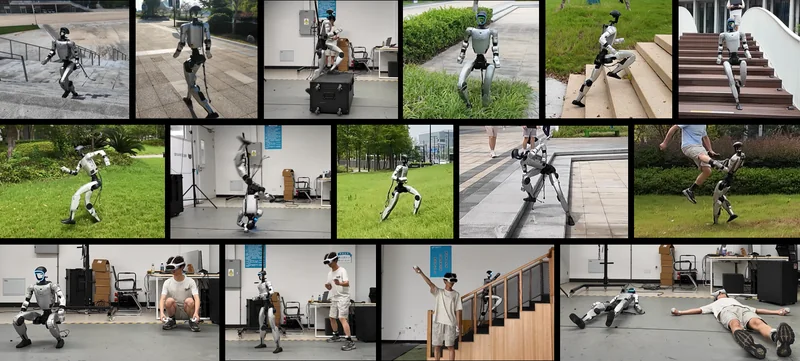
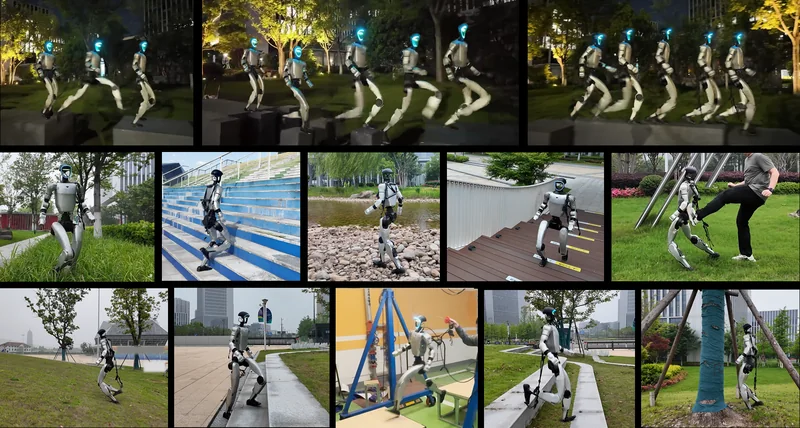
PGMT humanoid motion tracking across stairs and outdoor terrain.
A single policy deployed on Unitree G1 supports terrain-adaptive locomotion, whole-body motion tracking, teleoperation, and fall recovery.
TAGA2026 · Preprint

TAGA: Terrain-aware Active Gaze Learning for Generalizable Agile Humanoid Locomotion

Narrow beams, gaps, and sparse footholds leave little room for error. TAGA learns to focus on the terrain that matters next, enabling agile humanoid locomotion with onboard sensing.

TAGA humanoid traversing gaps, beams, and sparse footholds.
An active gaze module uses vision, proprioception, and motion commands to select terrain patches, which a cross-attention encoder fuses into the locomotion policy.
KiViIROS 2026 · Accepted

KiVi: Kinesthetic-Visuospatial Integration for Dynamic and Safe Egocentric Legged Locomotion

Glare and occlusion can undermine visual locomotion. KiVi combines vision with body sensing so a quadruped can navigate uneven terrain and stay stable when visual information degrades.

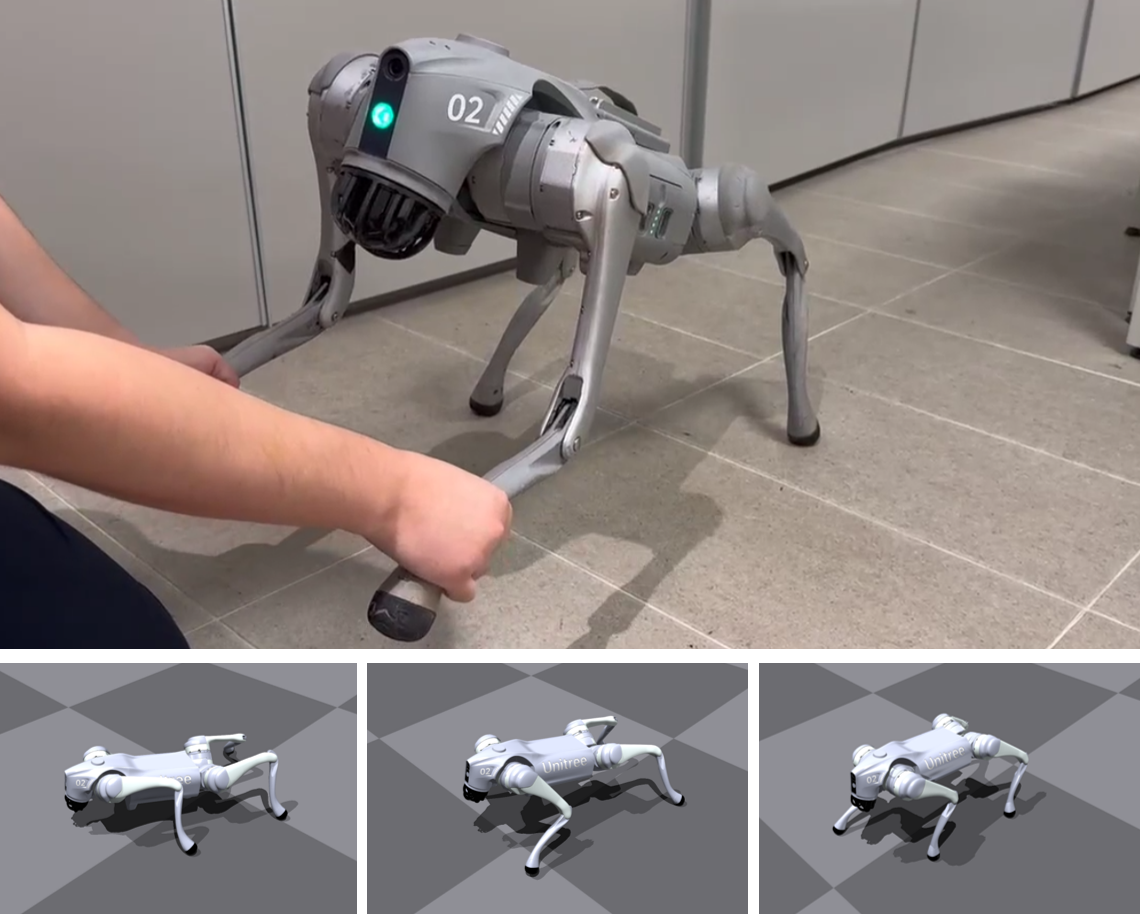
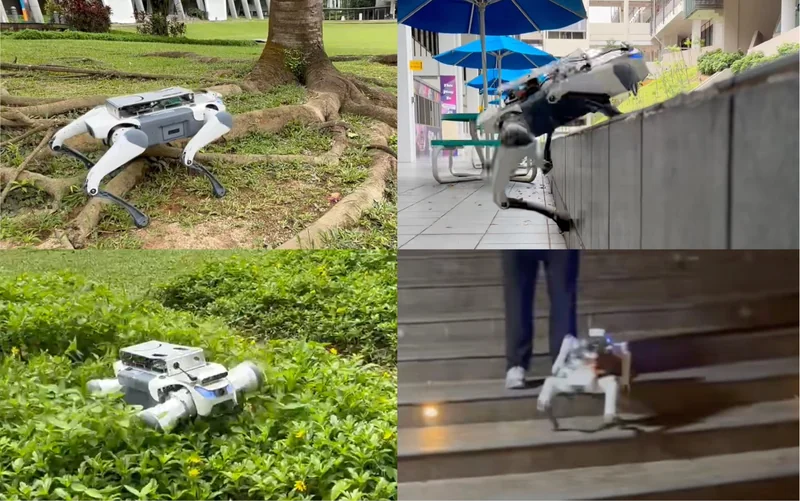
KiVi quadruped maintaining locomotion across varied terrain and visual disturbances.
A dual-branch estimator keeps proprioception as a stable base and uses memory-enhanced visual attention to add terrain information to the locomotion policy.

Collaborative work

SWAP2026 · Preprint

SWAP: Symmetric Equivariant World-Model for Agile Robot Parkour

Using symmetry in learned world models and control policies for agile quadruped parkour.

Paper
SWAP Figure 1: quadruped gap jumps, platform climbs, and outdoor parkour
STARTRA-L 2026

START: Traversing Sparse Footholds With Terrain Reconstruction

Reconstructing local terrain from onboard vision for precise foot placement across sparse footholds.

Paper
START Figure 1: sparse-foothold locomotion in simulation and the real world, with reconstructed terrain
HeLoM2025 · Preprint

HeLoM: Hierarchical Learning for Whole-Body Loco-Manipulation by a Hexapod Robot

Coordinating hexapod locomotion and foreleg manipulation to move objects toward desired poses.

Paper
HeLoM Figure 1: a hexapod pushing objects with its forelegs in simulation and real-world experiments
SATARSS 2025

SATA: Safe and Adaptive Torque-Based Locomotion Policies Inspired by Animal Learning

Learning torque-based locomotion inspired by animal movement for compliant, adaptive control and zero-shot transfer to real robots.

Paper
SATA Figure 1: compliant quadruped interaction with a person and simulated locomotion during training
Full publication list
  • 2026
    PGMT: Perceptive General Motion Tracking for Humanoid RobotsarXiv preprint
  • 2026
    TAGA: Terrain-aware Active Gaze Learning for Generalizable Agile Humanoid LocomotionarXiv preprint
  • 2026
    SWAP: Symmetric Equivariant World-Model for Agile Robot ParkourarXiv preprint
  • 2026
    START: Traversing Sparse Footholds With Terrain ReconstructionIEEE Robotics and Automation Letters · 11(2): 2194–2201
  • 2026
    KiVi: Kinesthetic-Visuospatial Integration for Dynamic and Safe Egocentric Legged LocomotionIROS 2026 · Accepted
  • 2025
    HeLoM: Hierarchical Learning for Whole-Body Loco-Manipulation by a Hexapod RobotarXiv preprint · Updated in 2026
  • 2025
    SATA: Safe and Adaptive Torque-Based Locomotion Policies Inspired by Animal LearningRobotics: Science and Systems

My path in robotics.

My work has grown from automation and robot systems to policy learning, perceptive locomotion, and whole-body control. Throughout, I focus on making learning work on real robots.

2025 — Present

Zhejiang University

Ph.D. student · Robotics

2023 — 2025

National University of Singapore

M.Sc. in Robotics

2018 — 2022

Beijing Institute of Technology

B.Sc. in Automation

Earlier engineering experience

Tsinghua University · AIR

Robotics Engineering Intern · Sep 2022 – May 2023

Worked on robotic arm control and robot system integration, including C++ / ROS development, simulation, and coordinated multi-arm demonstrations.

Institute of Process Engineering, CAS

Embedded Systems Intern · May – Jul 2023

Contributed to STM32 development and sensing and control circuit design, integrating hardware and software for practical systems.

Get in touch

For conversations about robot learning and control.

Citation

BibTeX